
Exploring List of Stock Exchanges in India: Cash and Commodity Exchanges

India’s financial systems are powered by strong, well-established exchanges where millions of transactions take place daily. These markets go all the way from stocks to agricultural produce and from retail investors to institutional giants, providing an organized platform of investment, hedging, speculation, and price discovery. This blog dissects the two major pillars of India’s exchange infrastructure-Cash Market (Equity Market) and Commodity Market-wherein the leading exchanges are highlighted as operating within each segment. Cash Market: The Foundation of Equity Investment Cash markets or equity spot markets are those where securities say stocks are exchanged for immediate delivery. In the cash market, ownership of shares is transferred and the payment is settled within a very short duration, normally T+1, where T is the date of the transaction. Cash market transactions are important for the long-term creation of wealth by providing an opportunity to invest in companies, earn dividends in return, and strengthen the portfolio. National Stock Exchange (NSE) Website: nseindia.com Inaugurated: 1992 Market Cap: Among the top exchanges in the world Key Index: Nifty 50 The NSE revolutionized Indian capital markets by introducing an electronic limit order book (LOB) trading system. With a focus on automation, transparency, and investor protection, NSE quickly became India’s largest stock exchange. Key Features: Products Traded on NSE: Nifty 50 index is a measure of India’s economic health, and tracks the top 50 companies across critical sectors. BSE (Bombay Stock Exchange): Products Traded on NSE: Nifty 50 index is a measure of India’s economic health, and tracks the top 50 companies across critical sectors. BSE (Bombay Stock Exchange): Website: bseindia.com Founded: 1875 (Oldest in Asia) Key Index: SENSEX BSE was formed in a time when trading was being held under a Banyan tree in Mumbai, today it has risen to become one of the fastest stock exchanges in the world with a transaction speed of 6 microseconds. Key Features: Key Offerings: SENSEX index representing 30 companies is measuring the mood of investors and 30 companies, representing India’s most-established blue-chip companies. Commodity Market: Trading Real-World Assets In commodity markets, the drama is all about the trading of raw or primary products, ranging from a commodity as cheap as grains and spices to metals and energy. Commodities are thus filled with price volatility for producers, manufacturers, and investors as one way to exploit trading opportunities. In India, two leading commodities exchanges are as follows: Multi Commodity Exchange (MCX) Website: mcxindia.com Founded: 2003 Regulated by: SEBI MCX holds the largest share in commodity trading in India. Price discovery and liquidity are considered efficient in metal and energy contracts. Popular Commodities on MCX: Precious metals: Gold, Silver Base metals: Copper, Zinc, Lead, Nickel, Aluminium Energy: Crude Oil, Natural Gas MCX helps businesses and speculators manage risk from globally traded commodities. National Commodity and Derivatives Exchange (NCDEX) Website: ncdex.com Founded: 2003 Headquarters: Mumbai NCDEX specializes in agriculture-linked commodities and offers a transparent platform connecting farmers with processors, traders, and exporters. Traded Commodities: NCDEX plays a key role in agricultural price risk management and – thus allows participants to lock in prices in advance through futures contracts. GIFT Nifty: Bridging Indian Markets with Global Investors GIFT Nifty – Traded via NSE International Exchange (NSE IX) GIFT Nifty is part of India’s broader plan to internationalize its financial services through GIFT City, Gujarat’s International Financial Services Centre (IFSC). It allows global investors to trade Indian index derivatives in USD. What Makes GIFT Nifty Different? Feature NSE/BSE GIFT Nifty (NSE IX) Currency INR USD Trading Hours 9:15 AM – 3:30 PM IST Two sessions: 6:30 AM – 2:30 PM & 3:30 PM – 11:30 PM IST Location India GIFT City (Offshore IFSC) Participants Domestic Investors Global Investors GIFT Nifty Products: Why It Matters: Metropolitan Stock Exchange of India (MSE) It is one of the three stock exchanges recognized by Indian law, the other two being NSE and BSE. MSE was brought into being to increase competition and innovation in Indian financial markets and provides a trading platform for equity, equity derivatives, debt instruments, and currency derivatives. Overview Website: www.msei.in Incorporation: 2008 Regulated by: Securities and Exchange Board of India (SEBI) Headquarters: Mumbai, India MSE has come into being to provide a modern and technology-driven trading environment to a wide market base and market participants. Even though it has relatively small trading volumes, MSE plays an integral part in bridging the financial markets, especially for those underserved populations such as Small and Medium Enterprises (SMEs) and regional investors. Key Offerings Equity Segment: Shares are traded concerning listed companies. MSE is promoting the listing of SMEs and startups so that an entrepreneurial growth environment flourishes. Equity Derivatives: Futures and options are based on both indices as well as individual stocks. Currency Derivatives: Contract in USD/INR, EUR/INR, GBP/INR, and JPY/INR. Change block type or style Move Heading block from position 78 up to position 77 Move Heading block from position 78 down to position 79 Change alignment Change text alignment Displays more block tools Exploring List of Stock Exchanges in India: Cash and Commodity Exchanges India’s financial systems are powered by strong, well-established exchanges where millions of transactions take place daily. These markets go all the way from stocks to agricultural produce and from retail investors to institutional giants, providing an organized platform of investment, hedging, speculation, and price discovery. This blog dissects the two major pillars of India’s exchange infrastructure-Cash Market (Equity Market) and Commodity Market-wherein the leading exchanges are highlighted as operating within each segment. Cash Market: The Foundation of Equity Investment Cash markets or equity spot markets are those where securities say stocks are exchanged for immediate delivery. In the cash market, ownership of shares is transferred and the payment is settled within a very short duration, normally T+1, where T is the date of the transaction. Cash market transactions are important for the long-term creation of wealth by providing an opportunity to invest in companies, earn dividends in return, and strengthen the portfolio. National Stock Exchange (NSE) Website: nseindia.com Inaugurated: 1992 Market Cap:
The Ultimate Guide for Derivatives: Futures and Options Trading

Introduction In derivatives trading, stock price changes are profit-making opportunities for the investors without them ever physically owning the stocks. It is a market that provides itself to risk management or making quick bucks. As of March 2025, the National Stock Exchange (NSE) contains 217 stocks in the Futures and Options (F&O) list. This proliferation manifests the growing importance of derivatives in the Indian market. Understanding futures and options is the key for traders and investors to survive in this highly competitive environment. The market activities are heavily regulated by SEBI, which promotes fair trading and transparency. Understanding Derivatives: An Introduction What Are Derivatives? Derivatives are financial contracts whose value varies with the price of some other asset, such as stocks. They are used either to protect investments or to make profits by betting on price moves. The principal types are futures, options, and swaps. These help traders to avoid risks or speculate on price changes without taking ownership of the actual asset. The Role of SEBI in Derivatives Trading SEBI, the Securities and Exchange Board of India, is the regulator for all derivatives trades. It formulates rules and regulations to keep the market safe and transparent. SEBI, in 2025, gave new directions for making the market more stable and less subject to manipulation while also protecting investors. These included tightening margin and trading limits. Benefits of Trading Futures and Options Futures and options offer many advantages to investors. They protect against losses(i.e., hedging). Speculators use futures and options to increase profits from small initial investments. Other derivatives help the discovery of fair stock prices and add transparency to the market. Exploring Different Types of Futures Contracts In the Indian financial markets, futures contracts are available across multiple asset classes — stocks, indices, commodities, and currencies. Understanding each type is crucial for traders and investors looking to diversify their strategies. Stock Futures Standardized: a contract between the two persons in which they determine the specific quantity of the stock to buy or sell at the predetermined future date for a particular price. At present, March 2025, 217 of the stocks in the Indian stock market are recognized for trading in F&O in NSE. This is further classified into different sectors, for example, banking, IT, automobiles, pharmaceutical sectors, etc. Example Companies Available for Stock Futures Trading: Company Name NSE Symbol Sector Reliance Industries Limited RELIANCE Energy/Conglomerate Infosys Limited INFY Information Technology HDFC Bank Limited HDFCBANK Banking Tata Consultancy Services TCS Information Technology ICICI Bank Limited ICICIBANK Banking Bharti Airtel Limited BHARTIARTL Telecom Larsen & Toubro Limited LT Engineering & Construction Bajaj Finance Limited BAJFINANCE NBFC (Financial Services) Key Features: Lot Size: Like all stock futures, all stocks have a defined lot size. For example, Reliance has 250 in the lot size where 250 shares constitute one lot. Margin Requirement: The trader must pay the initial margin amount which is generally 20-25% of the entire value of contract in trade. Settlement: Cash-settled on expiry of contract, which means no delivery of shares. 📌Stock Futures serves the purpose of Hedging towards individual stock positions or leveraged exposure into stock movement. 2. Index Futures Contracts based on an index rather than individual stocks are called index futures. These contracts provide wider market exposure with highly liquidity. Popular Index Futures on NSE: Index Name Description NIFTY 50 India’s flagship index comprising 50 major companies across sectors. BANKNIFTY Covers 12 of the most liquid and large-cap banking stocks. FINNIFTY Represents the diversified financial services sector (banks, NBFCs, insurance). MIDCPNIFTY Focuses on mid-cap companies. Popular Index Futures on BSE: Index Future Description S&P BSE SENSEX Futures Futures contract based on BSE’s 30 largest and most traded stocks. S&P BSE BANKEX Futures Futures contract tracking major banking sector companies on BSE. S&P BSE SENSEX 50 Futures Futures based on the top 50 companies listed on the BSE exchange. S&P BSE Bharat 22 Index Futures Futures based on a diversified basket of 22 Public Sector Enterprises (PSEs). S&P BSE 100 Futures Futures tracking the top 100 listed companies for broader market exposure. Key Features: Diversification: One index future represents a portfolio of stocks. Low Volatility: Compared to single stocks. Cash Settlement: No delivery of stocks at expiry — cash-settled based on index closing value. 📌 Index Futures work best for traders having a view on the general market or sector movement rather than on particular companies. 3. Commodity Futures Commodity Futures allow trading in essential goods like metals, energy products, and agricultural produce. In India, commodity futures are primarily traded on the Multi Commodity Exchange (MCX). Major Commodity Futures: Commodity Description GOLD A traditional safe-haven asset, ideal during economic uncertainty. SILVER Industrial and investment demand makes silver highly volatile. ZINC Widely used for galvanizing steel to prevent corrosion. COPPER Essential for construction, electronics, and manufacturing industries. CRUDE OIL Vital for the global economy; sensitive to geopolitical events. Key Features: 📌 Commodity Futures are useful for both hedging and speculation based on global supply-demand dynamics. 4. Currency Futures Currency Futures help traders hedge against currency risk or speculate on forex movements. These are traded on platforms like the NSE and BSE in India. Popular Currency Futures Pairs: Currency Pair Description USDINR U.S. Dollar against Indian Rupee. EURINR Euro against Indian Rupee. JPYINR Japanese Yen against Indian Rupee. GBPINR British Pound against Indian Rupee. Key Features: 📌 Currency Futures are essential for exporters, importers, and global investors managing foreign exchange risks. Options Trading: Deep Dive What Are Options and Types of Them Options give traders the right but not the obligation to buy or sell an underlying stock at a specific price before expiration. Options can either be exercised before expiry for example, American options, or at expiry only for example, European options. How Options Trading Operates Options can either be in-the-money (making money), at-the-money, or out-of-the-money. Pros and Cons of Options Trading They can be used to hedge or speculate. The losses will never exceed the premium paid. However, there is a risk of losing the premium if the
The Power of Asset Classes in Building Your Financial Future

An Asset Class in the Indian stock market (and in general investing) means a group of investments that behave similarly. Each asset class has its own risk and return profile. When people invest, they usually diversify across asset classes to balance risk. In the Indian context, the major asset classes are: 1. Equity (Stocks) 2. Debt (Fixed Income Instruments) 3. Mutual Funds: 4. Derivatives: 5. Commodities: 6. Real Estate Investment Trusts (REITs): 7. Infrastructure Investment Trusts (InvITs) : 8. Exchange-Traded Funds (ETFs) : 9. Currency: Asset Classes With Examples Conclusion Understanding the different asset classes helps you build a stronger, more balanced portfolio. Stocks, bonds, real estate, commodities, and alternatives each serve unique purposes. Your best strategy involves mixing them according to your goals and comfort with risk. Keep reviewing your investments regularly to stay aligned with market trends and your financial situation. Smart diversifying isn’t just a buzzword—it’s your ticket to better long-term success. For More Details, Click Here
BSE SURGES 80% IN 45 DAYS: Is This the Start of a Multi-Year Rally?
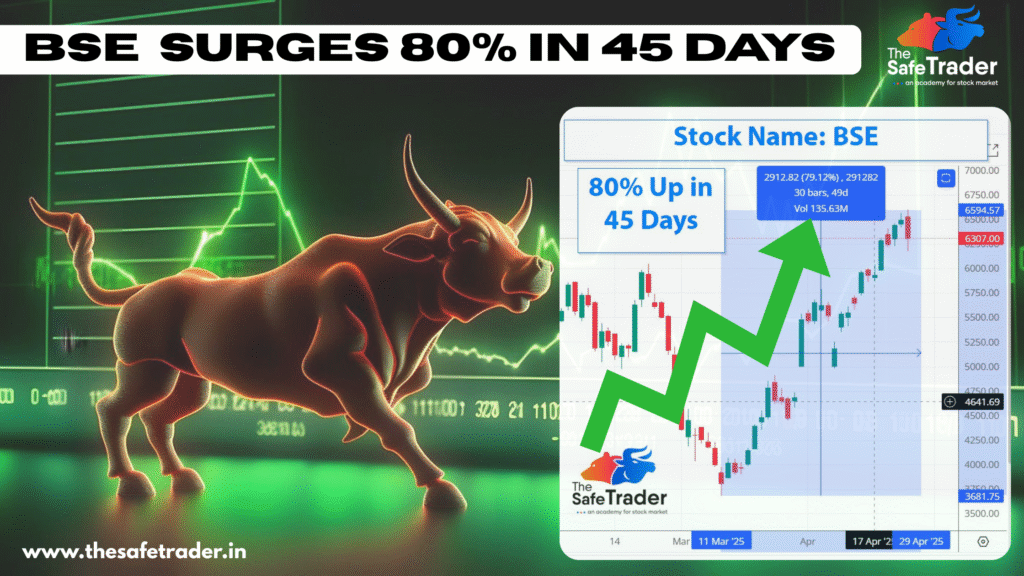
In a remarkable turn of events, BSE Ltd., Asia’s oldest stock exchange, has witnessed an impressive 80% surge in its stock price over the past 45 days. This significant uptick has caught the attention of investors and market analysts alike. About BSE Ltd : Established in 1875, BSE Ltd. (formerly Bombay Stock Exchange) is a premier stock exchange in India. Beyond facilitating equity trading, BSE offers services in derivatives, mutual funds, and SME platforms, playing a pivotal role in India’s financial ecosystem. Recent Stock Performance This surge is particularly noteworthy given the broader market dynamics and BSE’s historical performance. Factors Behind the 80% Rally The stock of BSE Ltd. has shown commendable performance on all counts due to the following factors: 1. Record High Trading Volumes Increase in participation in the Indian stock market; more retail investors in the fray. Increase in trading volume directly benefited BSE through transaction fees. 2. Growth in Derivatives Segment BSE’s strategic focus on expanding derivatives offerings, especially index options and futures, is starting to pay dividends as it attracts an even wider investor base. 3. Success of the SME Platform The BSE SME platform has become a preferred choice for small and medium enterprises that run after acquiring public listings. This would have brought in extra revenue for the settlement. 4. Technological Advancements Investment in technology has certainly benefited BSE in enhancing trading infrastructure providing speed with reliability, which drew due participants. 5. Positive Market Sentiment General bullish sentiment prevailing in the Indian equity markets has continued to spill over into stocks with a focus on financial infrastructure, making BSE Ltd. richer by value. Stock Performance Snapshots BSE Ltd. stock has gained about 80% till April 25, 2025, in the last 45 days. The appreciation reflects the fundamentals of the company and development perception of the investors on the financial sector in India. Investment Considerations With the recent rally showing strong legs, potential investors should consider the following: Valuation Metrics: Assess if the current stock price reflects the company’s earnings growth prospects. Market Competition: Understand BSE-specific competition issues relative to the National Stock Exchange (NSE). Regulatory Environment: Check for any regulatory changes that may impact the exchange operation. Technological Disruption: Follow technologies to watch out for that may disrupt trading platforms or affect investor behaviour. Conclusion The BSE Ltd. 80% appreciation in 45 days underscores the volatility of the Indian financial markets and the pivotal role of the exchange therein. While the prospects seem bright, the investor should conduct proper due diligence, considering both the opportunity and possible risks attached to a rapid surge in price.
Understanding Stock Analysis — Overvalued, Undervalued, and Fairly Valued Stocks

If you’ve ever thought about investing in the stock market, you’ve probably heard the term stock analysis. It sounds technical, maybe even intimidating—but it doesn’t have to be. In fact, learning how to analyze stocks is one of the smartest moves any investor can make. What is Stock Analysis? Stock analysis is described as the process by which the earnings, management ability, and performance of a company are taken into consideration to determine whether it would be a good investment proposition. Each analysis project sets out to find out if the stock is In general, there are two major forms of stock analysis: 1. Fundamental Analysis This type aims mainly at the study of financial statements, business model, industry, and economic front of the company. The question is whether this is a strong company to consider investing in for the long haul. 2. Technical Analysis This form analyzes price changes, trading volume, and formations on various charts. It’s more of a question of timing; you want the entry and exit points of your transactions to follow the prevailing trend of the marketplace. What is an Overvalued Stock? A stock is said to be overvalued if the share price exceeds the intrinsic value, which is justifiable only by certain fundamental factors such as earnings, revenue, or growth prospects. This situation may have arisen due to speculation, hype, or simply unreasonably optimistic expectations from investors. Overvaluation can be defined simply as a price higher than a value derived for the company valuation, and this may inject uncertainty into the situation if the share price adjusts with time to reflect its actual value. How to Analyze Overvalued Stocks: This is how one can detect and assess a stock is overvalued, through real data-driven analysis: 1. Look at P/E Ratio (Price-to-Earnings) Formula: P/E = Share price ÷ Earnings per share The high P/E means the market expects a lot of future growth. But when growth doesn’t happen, the stock collapses. Example: If a company had a P/E of 100, it means investors pay 100 dollars for every dollar earned currently. That is a steep bet. 2. Check the PEG Ratio (Price/Earnings to Growth) Formula: PEG = (P/E) ÷ Annual EPS Growth Rate A PEG over 1.0 often signals overvaluation. Example: If a stock has a P/E of 60 and expected growth of 20%, the PEG is 3. That’s considered overpriced. 3. Compare Price-to-Book (P/B) and Price-to-Sales (P/S) This is how much a shareholder pays on an average for a possible future payback on the company’s assets and sales. High P/B = paying more than the company’s asset value while high P/S = paying more than the company earns in revenue. Value investing usually goes for lower figures. Unless in a very high-growth industry. 4. Track Revenue and Earnings Growth Look at past performance and forward guidance. Warning signs: 5. Insider Trading Scenario Selling major blocks of a company’s stock by insiders is really worth checking out because it may mean that they think there is something unmanageable about the current price. Intelligent Money Advice: Use tools like Yahoo Finance, OpenInsider, or Finviz to track insider actions. 6. Compare with Industry Peers: Is the company an outlier with its valuation? Example: If a streaming company has a P/E of 90 while comparison companies at 20-30, demand a reason why. 7. Discounted Cash Flow (DCF) Analysis: This is the gold standard to determine how true the price of a stock really is. It forecasts cash flows into the future and discounts them to the amount today. If the stock trades far higher than your DCF estimate, it is probably overvalued. What is an Undervalued Stock? An Undervalued Stock, it is defined as a stock that is considered to trade at lower than its intrinsic value; in other words, a value below that which the market feels is correct. So Why does it Happen? How to Analyze Undervalued Stocks (Step-by-Step) 1. Compare PE with Industry Average The formula is P/E = Share Price/Earnings Per Share (EPS) If the P/E ratio is lower than average, it might be undervalued. But check whether earnings are stable or growing. For example: A company having a P/E of 9 and its industry average is 18 can be seen as undervalued, but only if the fundamentals are strong. 2. Look at the PEG Ratio Formula: PEG = P/E divided by Expected Earnings Growth A PEG smaller than 1.0 is generally an indication of undervaluation. A cheap stock in relation to its expected growth. 3. Check the Price-to-Book (P/B) Ratio Formula: P/B = Share Price ÷ Book Value per Share When the P/B ratio is less than 1, you’re spending less than the company’s net asset value. You can find it especially useful for banks or real estate companies. A company with a book value of $20 per share has a market trade price of $15. There you can get notice of a possible bargain. 4. Study the Price-to-Sales (P/S) Ratio Formula: P/S = Market Cap ÷ Revenue A low P/S ratio (generally less than 1) suggests that such stock prices have an undervalued nature. This comes into play when a company shows above-average sales performance but poor short-term profits due to high one-time expenditures. 5. Analyze Free Cash Flow Free Cash Flow (FCF) refers to the extra cash generated by a company after all the expenses have been paid off. High performance in FCF implies that a company can do To invest at a low price with positive FCF, well, this can be a good mix for sure. 6. Look for Temporary Problems Most common temporary problems for undermine stock: The key question is, short-term hick-up or long-term problems? Assuming the business fundamentals remain firm, it could be just a small dip hence a great buy. 7. Use Discounted Cash Flow (DCF) Analysis It is a very advanced but powerful technique employing forecasting of future cash flows to evaluate the actual worth of a stock. If the market price is much
Understanding the Risk-Reward Ratio in the Stock Market: A Guide for Smarter Trading

Probably the key concept that an investor or trader needs to comprehend is the Risk-Reward Ratio (RRR). This method can either make or break an investor, whether he has been in the business for years or just entering it. One really knows the RRR to sway his success and decision-making in the financial markets. What Is the Risk-Reward Ratio? The risk-reward ratio (RRR) is a measure that compares the potential profit of a trade to the potential loss. It helps investors and traders evaluate whether a trade is worth taking. Formula: For example, if you are willing to risk $100 for a potential profit of $300, the risk-reward ratio is: This means for every dollar you risk, you stand to gain three. Why Is It Important? How Indian Traders Use the Risk Reward Ratio Let’s take a real-world-style example from the Indian markets: Risk = ₹500 – ₹450 = ₹50Reward = ₹650 – ₹500 = ₹150 You’re risking ₹50 for the chance to make ₹150. This is generally considered a favorable setup. Common Mistakes Made by Indian Investors What’s a Good Risk-Reward Ratio? Most experienced Indian traders aim for a minimum of 1:2 or 1:3 in their trades. A 1:2 ratio means you stand to gain ₹2 for every ₹1 you risk. The higher the ratio, the more cushion you have for losses. Tips to Use Risk Reward Ratio Effectively Final Thoughts The risk-reward ratio is a foundational principle of successful trading. It helps you think in terms of probabilities and manage risk like a pro. Whether you’re investing in Nifty 50 stocks, mid-caps, or even F&O, understanding and applying RRR can significantly improve your long-term success.
All About Altcoins: What You Need to Know

Altcoins, or alternative cryptocurrencies, were introduced after Bitcoin to address its limitations and offer diverse functionalities. They include popular options like Ethereum, Litecoin, and Ripple, each catering to different use cases. Altcoins provide investors with various opportunities in the rapidly growing cryptocurrency market. What is Altcoin? The term “altcoin” is derived from “alternative” and “coin,” referring to any cryptocurrency other than Bitcoin. Whereas Bitcoin was the first cryptocurrency in order of creation, other developers were making new projects after Bitcoin’s establishment to improve on its faults and add new functionalities. These are now generally known as the altcoins. Altcoins are called so because they usually serve one or more of the following purposes: speed transaction, enhance privacy, and support decentralized apps. A Quick History of Altcoins: In 2009, the pseudonymous inventor of Bitcoin, Satoshi Nakamoto, introduced the concept of decentralized digital currency to the world. Soon, however, as the limitations of Bitcoin became evident-such as slow transaction speeds and high energy consumption-developers began to devise competing alternatives. The first significant altcoin was Namecoin, launched in 2011; followed by Litecoin, known as “silver to Bitcoin’s gold,” and Ripple (XRP). Each new altcoin sought to remedy or add something that Bitcoin lacked-whether speed, privacy, or functionality. Since then, the world has exploded in hundreds of thousands of cryptocurrencies and the growth continues day by day. What Makes Altcoins Different from Bitcoin? Altcoins differ from Bitcoin in several crucial aspects, even though they all use blockchain technology to exist. Purpose: Some are intended to allow for smart contracts (such as Ethereum), others to facilitate quick payments (like Dash or Litecoin), while some further enable specific decentralized apps. Technology: Different consensus algorithms (such as Proof of Stake rather than Proof of Work) are employed by many altcoins to achieve faster speeds or lowered energy consumption. Governance: Many more recent altcoins give their holders the right to vote on alterations to the network because this is not directly done in Bitcoin. Types of Altcoins In general, altcoins can be classified into several different types according to their use cases and the technologies that underlie them. Here are some of the common types: 1. Stablecoins Stablecoins aim to limit price volatility by being pegged to a stable asset, such as the US Dollar and, in some instances, other fiat currency. Stablecoins are stable, which makes them great for transactional and trading purposes. Examples: Tether (USDT), USD Coin (USDC), Binance USD (BUSD) 2. Utility Tokens Utility tokens provide access to a platform or service within an ecosystem created by a particular blockchain. It is generally used to pay for services, governance, or transaction fees. Examples: Ethereum (ETH), Chainlink (LINK), Binance Coin (BNB) 3. Security Tokens Security tokens are the representation of ownership of an asset like shares in the company or real estate. These tokens fall under federal security regulations. Examples: Polymath (POLY), tZERO (TZROP) 4. Meme Coins Meme coins emanate from Internet memes or jokes yet gain popularity mostly due to community interests and social media hype. Examples: Dogecoin (DOGE), Shiba Inu (SHIB) 5. Privacy Coins Privacy coins work toward achieving privacy in transactions by hiding the details concerning the sender, receiver, and the amount transacted. Examples: Monero (XMR), Zcash (ZEC) How Altcoins Operate? Altcoins make use of the blockchain technology – a distributed, decentralized public ledger recording all transactions. Many altcoins rely on some variants of the Proof-of-Work (PoW) and Proof-of-Stake (PoS) consensus strategies to qualify and establish security for transactions. Proof-of-Work (PoW): To authenticate the transaction and secure it, miners must solve mathematical problems. Construction of New Blocks Proof-of-Stake (PoS): Validators nominated to produce new blocks are selected depending on the amount of cryptocurrencies they have, which is provided as collateral for this block. With some altcoins, there are special consensus algorithms such as Delegated Proof of Stake (DPoS) and Proof of Authority (PoA) that help in enhancing the efficiency and scalability. What indeed are Altcoins? They matter mainly in building up the blockchain ecosystem. They also open new avenues, enhancing much of Bitcoin’s demerits, further purposing diversity. Here is a quick list of some of the best advantages: Faster Transaction Speeds – A lot of altcoins process transactions faster than Bitcoin. Reduced Transaction Rates – Altcoins generally charge fewer transaction fees compared to the Bitcoin network. Good Privacy – This category of altcoins supports anonymity for its users. Other Diverse Use Cases – Altcoins are meant to drive decentralized applications, smart contracts, and tokenomics. Great Altcoins to Observe by 2025 The things that have seen almost everything, particularly these two phenomena, are the explosive growth of altcoins and, of course, the expanding cryptocurrency market. Here are some of the most exciting altcoins to watch: Ethereum (ETH): The second-largest cryptocurrency responsible for decentralized applications and smart contracts. Cardano (ADA): A scalable and secure blockchain platform. Solana (SOL): Quick with low prices for transactions. Polkadot (DOT): Chains from different blockchains can now communicate with each other. Avalanche (AVAX): Your customizable blockchain networks powered by a decentralized platform. Risks of Altcoins Investment They come with a big amount of risk. Right now, the altcoin space is the most rewarding but it carries as much risk. Most price bubbles burst into thin air when the volatile crypto market creates sharp spikes or drops in price, and a lot of altcoins do not seem to be able to outlast the market over time. Investors should hence do proper research and risk analysis before investing. Conclusion Altcoins rocked the emerging crypto space by presenting creative options and diverse opportunities for investment, apart from Bitcoin. Whether your passion lies in smart contracts, coins for privacy, or utility tokens, altcoins are the right avenue for every investor. However, you must understand the technology behind, utility, and market dynamics to make the best investment decisions. If you want to diversify your cryptocurrency portfolio or try out state-of-the-art blockchain technologies, these fantastic altcoins would do the trick. And remember to DYOR about the latest happenings in the cryptosphere!
Banking Boom! Bank Nifty Tops 55,461 for the First Time Ever

The Indian banking sector is now shining bright in the bullish world as the Bank Nifty climbed to yet another all-time level of 55,461 on 21st April 2025. This surge, with momentum from the splendid Q4 earnings, buoyant credit growth, and renewed interest from foreign investors, denotes strong fundamentals and continuous investor confidence in the Indian banking story. Here, we shall take a deep look at what was backing this surge, which banks are leading the charge, and what all traders and investors should watch for next. Market Recap: What Happened Today? Opening Bell: The index opened strong at 54891.25, fuelled by global cues and positive sentiment in the domestic market. Intraday Range: Bank nifty made an intraday high of 55461 before closing right around that mark. Volume Spike: A lot more volume was seen today compared to the averages, indicating aggressive and active participation by institutional and retail investors. Top Gainers in Bank Nifty HDFC Bank was able to achieve great, almost 2.7%, results, thanks to improved margins and solid advances in the increased interest income. ICICI Bank benefited from good post-results behavior, thanks to good NIMs and expansion in the loan book. Axis Bank and Kotak Bank gained over 1.5% due to positive sentiment and improving cost-to-income ratios across the sector. IndusInd Bank and Federal Bank also rallied in anticipation of Q4 results. The Key Drivers Behind This Rally 1. Strong Q4 Results The earnings momentum started from HDFC Bank and ICICI Bank, which, both in fact, delivered strong results above expectations. Major positives are as follows: 2. Fresh FII Buy Foreign Institutional Investors have returned with a vengeance into the Indian equities market, with banks being a favorite play. The money inflows form an important liquidity cushion, elevating valuations and sentiment. 3. Credit Growth & Digital Lending Boom Whenever RBI data speaks of growth in double digits, be it credit growth mostly of retail & SME nature, it fortifies yet another example of the rise of digital loans along with fintech partnerships breathing yet again into this whole sector of traditional banks. Any Risks Ahead? Although the rally appears to be on solid ground, the following areas will be subject to caution: However, a very healthy cushion exists from their strong balance sheets, large provisioning buffers, and much-improved cost efficiencies. What Are Analysts Saying? “The Bank Nifty’s breakout above 55,000 opens up potential for a rally towards 56,000–56,200 in the near term,” — said a senior technical analyst at Motilal Oswal. “Valuations are not stretched yet, and continued earnings upgrades may fuel further upside,” — noted a fund manager at SBI Mutual Fund. What to Watch Next? Coming up next are banking earnings: for Kotak Bank, SBI, and the smaller private/public banks. RBI Policy: Any dovish hints or pause in rate hikes would provide tailwind. Global Macro Events: Oil prices, US inflation data, and Fed speak may influence short-term sentiment. Conclusion Bank Nifty’s new high isn’t purely technical: It deeply reflects the bank sector development in India transforming itself structurally towards adapting to the digital, macroeconomic, and regulatory shifts. As it drags through the earnings season and with buoyant credit growth, it may well scorch new highs in the weeks to come. Markets are moving — are you? Connect with The Safe Trader Academy and trade smarter.
Turn Expert Moves Into Your Profits

The contemporary financial landscape is in constant change. Within this context, Copy Trading, as it is popularly known, is a game changer for individuals interested in profiting from the expertise of professional traders without active portfolio management. Thanks to copy trading, it now also opens its doors to trading for beginners and investors who often find themselves against time. Equipped with only a mouse and minimal initial capital, anyone can now invest like a pro. This article discusses the other considerations for copy trading, including its workings, advantages, disadvantages, and tips for success. What is Copy Trading? Copy trading may be defined as an automating trading system whereby investors copy the trade of a professional trader with years of experience and success. The trade of buying or selling an asset made by somebody you have chosen to follow will trigger an automatic buy or sell entry in your own trading account at that same moment in time. In this way, you benefit from all of the potential gains or losses alongside the professional, without putting any thought into the trading decision whatsoever. Thus, copy trading tries to resolve the problem that retail investors meet in getting nearer to professional traders. It works by linking the account of the copier with that of a trader who has been selected purposely. All actions of the professional trader are then replicated in the copier’s account in proportion to the amount of capital allocated. If, for instance, the trader you copied would put 5% of his portfolio into a certain stock, you would also allocate the same proportion to your account. This, therefore, renders copy trading a passive but really smart investment strategy. How Copy Trading Platforms Work Copy trading is an activity that requires an investor to sign up with copy trading platforms or brokers. Below is a quick summation of how it works: Step 1: Register on a Copy Trading Site Platforms like eToro, ZuluTrade, NAGA, and MyFXBook provide good interfaces to browse, analyze and select traders to copy. These platforms aggregate various traders with diverse strategies and performance tracking. It helps copiers know what to do before starting. Step 2: Analyze Trader Profiles All traders on a copy trading platform have an extended profile by virtue of which detailed data is found about their trade performance using different assets, win rates on trades, drawdown levels, risk scores, historical returns, etc. This helps copiers filter and compare traders on a basis of such criteria, such as profitability, number of copiers, trading style, and so on. Step 3: Capital Allocation Whenever a trader is selected by the copier, the copier allocates towards copying that trader part of his total capital. The amount allocated can be altered over time in accordance with the copier’s preferences and risk appetite. Step 4: Operation of Trading Automatically Any time that the copied trader opens, changes, or closes a position, the same action performs automatically within the copier’s account. The amount of capital the copier allocated determines how the trades are proportioned to the copier and ensures that the returns (and losses) are in sync with the chosen trader’s performance. Step 5: Monitoring and Changes Copy trading is mostly automated. It is thus crucial for copiers to keep a close tab on how their selected trader(s) do from time to time. Investors have the option of halting copying, reallocating capital, or changing a certain trader if their performance does not meet the expected outcome. Check Out These Successful Copy Traders! Check Copiers, Return History, Profitability, Leverage, and Risk to choose the right trader Types of Copy Trading Models Modified forms of copy trading are available to accommodate investors’ different needs in some cases. This flexibility is helpful when one invests in the model that matches one’s goals and risk exposures. 1. Manual Copy Trading For manual copy trading, investors carry out the analyses and selections of the trades they want to copy. This may be considered the main drawback of having less control over what trades will be copied. But on the flip side, it requires some level of understanding of the markets and perusing every opportunity for trading. 2. Automated Copy Trading This is indeed the most popular and easiest model, wherein all trading decision making and thus their executions are immediately mirrored in the account of the copier. The moment a trader is chosen and the capital allocation made, the system takes control of everything in real time. 3. Social Trading As an extension of copy trading, social trading brings community features to the service: it allows users to copy trades but can also interact, discuss strategies, and share insights into market trends with other traders. In combining the benefits of copy trading with those of collaborative learning, social trading yields an improved form of copying. Key Benefits of Copy Trading 1. Perfect for beginners: Beginners can skip most of the rocky process of learning by depending on the skill of professional traders. Copy trading reduces the engagement of much technical analysis or even deep market knowledge. 2. Save Time and Energy-it is hassle-free for pre-occupies individuals without time to study markets or plan trading strategies. 3. Obtaining Different Strategies-It allows all investors to experiment with different trading styles like day trading, swing trading, or longer investment by copying more than one trader using another approach. 4. Spreading the Risk-Investors can follow different traders or approaches and thus have more risky portfolios to reduce the overall risk associated with depending on a particular strategy. 5. Transparency with Real-Time Insights: Most copy trading platforms offer a complete transparency perspective with a clear record of historical data performance, risk levels, and trading patterns of the professional traders, which provides the necessary foundations to make informed decisions. 6. Learning It also becomes an application through which beginners can learn the reasons for specific trades by watching expert proceedings about market trends. Challenges and Risks in Copy Trading If copy trading has a lot of benefits, it still poses
Indian Stock Market : Key Insights and Trends in 2025

Market Overview The Indian stock market has finally started to recover after its long stagnation. Key indices like Nifty 50 have rallied in recent trading sessions, with many large stocks also giving spectacular returns. While the market faces challenges, such as the IT sector not doing very well, it appears to be on the mend, with sectoral recoveries, positive FII inflows, and global cues regarding the price movements of gold and crude oil aiding the recovery. 1. Nifty 50: Strong Recovery of 10% Nifty 50 Closing (April 17, 2025): 23,851.65 The Nifty 50 has bounced back against the lows by 10 percent in the last seven days to close at 23851.65 on April 17, 2025. This rally has been backed by sectoral support largely coming from banking, energy, and metals. The more robust the rally, the more the market seems to be stabilizing after prior corrections. 2. Reliance Industries: Strong Uptick of 15% Reliance Industries : ₹1,274.50 (₹35.20 or 2.84%) 7-Day Growth: +15% Reliance Industries surged 15 percent in value over the past week to close at Rs 1274.5 per share, benefiting from a diversified business model, covering telecom, retail, and energy. Rising crude oil prices have also buffeted the $200 billion company’s energy and petrochemical arms. 3. FII Flows: Positive Sentiment Returns Foreign Institutional Investors (FII) have started to return to the Indian stock market, signaling a shift in sentiment. After a period of cautious outlook, the return of foreign capital has been one of the key factors driving the market’s recent uptrend. This renewed interest in Indian equities reflects growing optimism about India’s economic recovery. 4. Recovery in Key Sectors: Sectoral Rebounds Those sectors which experienced a lot of losses during the earlier months are now galloping towards recovery. Well among the key sectors: Banking Sector: The three banks- HDFC Bank, SBI and ICICI Bank are continuously posting lifetime highs, thanks to excellent earnings and brightened expectations on credit growth. Energy Sector: With the revival of crude oil prices, Reliance Industries and all other energy companies captured a golden chance. Metals: Companies in metals will immediately get an upward thrust after the international commodity price recovery. 5. Global Factors The Tariff War Comes to a Standstill, Energy Elements Requisite for Crude Oil Recovery The tariff war between major global economies has become a mere shadow, maintaining a low level of uncertainty in the global market. Its halts will encourage growth in trade-sensitive sectors. Moreover, crude oil price recovered to $64.68 per barrel and will cultivate famous winds for energy crews like Reliance Industries and ONGC. 6. Gold Price Soars to All-Time Highs Gold Price: ₹100,000 per 10 grams Gold has reached its all-time maximum of ₹100,000 for 10 grams. Currently, the buzz in gold prices is propelled mainly by global economic discontinuities, inflation fears, and a move towards safe haven assets. With a mass inflow of global investors into gold, it would perhaps mean a general caution towards economy-related issues. 7. Peaked Crude Oil Prices Crude Oil Price : $64.68 per barrel (+2.21%) Moving up in price, crude oil now stands at $64.68 per barrel and up 2.21%. Supply-side disruptions combined with recovery in general demand support the rise in crude prices; thus, benefiting companies in the energy chain and oil refining sector, among which Reliance Industries may be benefited in the process. 8. Strong Performers in the Banking Sector The banking sector has become one of the strong performers in 2025, with several top banks reaching fresh lifetime highs. These banks have rewarded investors with 18% returns in 2025 so far, touching new all-time highs with HDFC Bank, ICICI Bank, and State Bank of India. Axis Bank, specifically, was a good performer, giving 28% return during 2025, thanks to solid growth in retail banking and digital adoption, along with a growing loan book. 9. IT Sector: Infosys and TCS in Trouble: A major troublemaker for the IT sector, Infosys and TCS have seen 28%-to-30% losses so far in 2025. Several reasons to account for these underperformances are: Global Economic Slowdown: Poor demand for IT services in key international markets, such as the US and Europe. Increasingly Competitive: Undercutting competition from newly emerging markets, with particular reference to Eastern Europe and Southeast Asia. Technological Disruption: The automation and Artificial Intelligence Highway is reducing demand for traditional IT outsourcing services. Conclusion: A Dynamic Market in Transition The month of April 2025 has seen a remarkable turnaround in the Indian stock market owing to surges in one sector or another, favorable performance from banks, and raising investor confidence. The last seven trading days have seen Nifty 50 recover by 10%, led by banking and energy sector stocks on a rally that has seen Reliance Industries gain around 15% from recent lows with gold touching a new all-time high. The market will not be kind to all sectors. While banking, energy, and commodities may see positive technicals to continue in their upward momentum, it is the visible weakness of the IT sector that serves as a reminder to investors of the importance of macroeconomic and technological disruption forces in judging the performance of a certain stock. Investor opportunities versus challenges remain. Investors must focus on maintaining a diversified portfolio and sectoral analysis while dealing with such an extraordinary market.